


Tax payable for FY 2024-25 (AY 2025-26), new regime, salary income only, cess included
| Gross salary | Taxable income | Tax payable |
|---|---|---|
| ₹7,75,000 | ₹7,00,000 | ₹0 |
| ₹8,00,000 | ₹7,25,000 | ₹23,400 |
| ₹9,00,000 | ₹8,25,000 | ₹33,800 |
| ₹10,00,000 | ₹9,25,000 | ₹44,200 |
| ₹12,00,000 | ₹11,25,000 | ₹71,500 |
| ₹15,00,000 | ₹14,25,000 | ₹1,30,000 |
| ₹20,00,000 | ₹19,25,000 | ₹2,78,200 |
The table assumes a resident individual below 60, the standard deduction of ₹75,000 and no other deductions. Surcharge does not apply at these levels.
Calculate my FY 2024-25 tax
If you are searching for an income tax calculator FY 2024-25 in November 2026, the year is already closed, and that changes what you need. Some of you want to check what your tax should have been. Some never filed and want to know how bad it is. Others have a Form 16 figure or a notice that does not match their own math. This guide from The Vishal Media covers all three: a calculator, the exact rules that applied that year, and a clear path if you are behind.
Income Tax Calculator FY 2024-25: Enter Your Salary and Compare Both Regimes
Income tax estimate for FY 2024-25 (AY 2025-26)
This is an estimate for a resident individual using the rules that applied for FY 2024-25. It does not cover capital gains, income taxed at special rates, alternative minimum tax or business income. Confirm your final numbers with a Chartered Accountant before filing.
Enter your annual salary, pick the old or new regime, and add deductions if you use the old one. This salary tax calculator shows tax before cess, the cess, and the total, with both regimes side by side. Prefer a quick lookup? The salary table at the top of this guide covers common salaries, and the calculator uses the same slabs.
FY 2024-25, AY 2025-26 and “Tax Year”: Which Is Which?
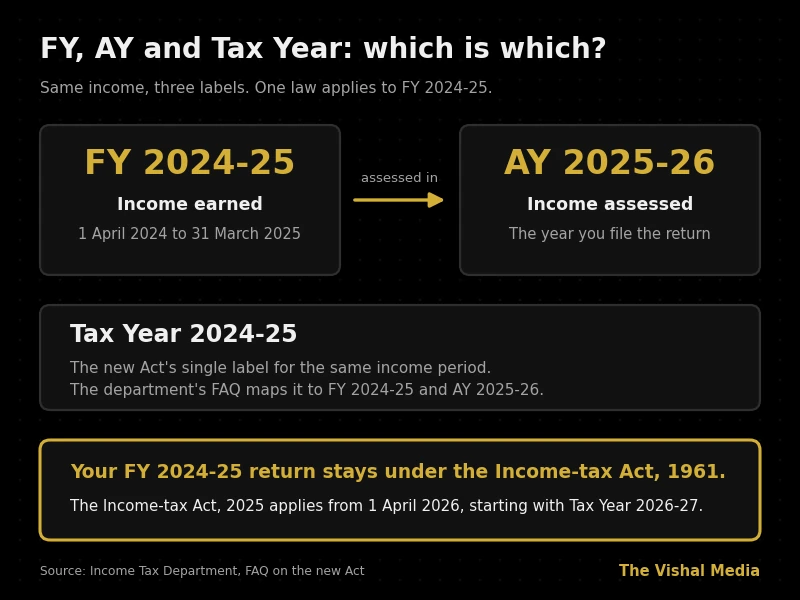
FY 2024-25 is when you earned the income, from 1 April 2024 to 31 March 2025. AY 2025-26 is the year the Income Tax Department assessed it. The Income-tax Act 2025 came into force on 1 April 2026 and the 1961 Act was repealed, and it uses a single label, “Tax Year”, instead of two. The department’s FAQ on the new Act maps Tax Year 2024-25 to AY 2025-26.
For your FY 2024-25 return, none of this changes the maths. Returns for AY 2025-26 stay under the 1961 Act, so the old section numbers (139, 234F, 115BAC) are the ones that apply. One trap: the department’s online calculator is now titled for AY 2026-27, so check the year before trusting any number it gives you.
Income Tax Slabs FY 2024-25: New Regime
The income tax slabs FY 2024-25 under the new tax regime (Section 115BAC) were nil up to ₹3 lakh, then 5% to ₹7 lakh, 10% to ₹10 lakh, 15% to ₹12 lakh, 20% to ₹15 lakh and 30% above that.
| Taxable income | Rate |
|---|---|
| Up to ₹3,00,000 | Nil |
| ₹3,00,001 to ₹7,00,000 | 5% |
| ₹7,00,001 to ₹10,00,000 | 10% |
| ₹10,00,001 to ₹12,00,000 | 15% |
| ₹12,00,001 to ₹15,00,000 | 20% |
| Above ₹15,00,000 | 30% |
What you could subtract before applying these slabs was short:
-
Standard deduction ₹75,000: raised from ₹50,000 for salaried employees in the Union Budget.
-
Employer NPS: contributions under Section 80CCD(2) up to 14% of salary, and a family pension deduction of ₹25,000.
-
Not available: 80C, 80D and HRA exemption. That trade-off is what makes the regime choice interesting.
The Section 87A rebate is what creates the ₹7.75 lakh tax-free figure. It covers up to ₹25,000 of tax when taxable income is ₹7 lakh or less, and it cancels the slab tax of ₹20,000 exactly. Just above ₹7 lakh, marginal relief caps your tax at the amount by which you exceed ₹7 lakh. That relief runs out at roughly ₹7.22 lakh of taxable income. Cess is 4% on top. Surcharge starts only above ₹50 lakh, so it does not touch most salaried readers.
Income Tax Slabs FY 2024-25: Old Regime
The old tax regime kept its structure from earlier years. The boundaries stayed at ₹2.5 lakh, ₹5 lakh and ₹10 lakh for people below 60. These are also the AY 2025-26 tax slabs for the old regime.
| Taxable income (below 60) | Rate |
|---|---|
| Up to ₹2,50,000 | Nil |
| ₹2,50,001 to ₹5,00,000 | 5% |
| ₹5,00,001 to ₹10,00,000 | 20% |
| Above ₹10,00,000 | 30% |
Senior citizens (60 to 80) had a higher ₹3 lakh basic exemption, and those above 80 had ₹5 lakh. The 87A rebate in the old regime was just ₹12,500, available only up to ₹5 lakh of taxable income. The standard deduction was ₹50,000.
Where the old regime earns its keep is deductions. Section 80C works up to ₹1.5 lakh in aggregate, 80D up to ₹25,000 for self and family (₹50,000 for senior citizens), and the NPS deduction under 80CCD(1B) up to ₹50,000. HRA exemption and home loan interest sit on top of that.
Worked Examples
Example 1: ₹7,75,000 salary, new regime
Subtract ₹75,000 and taxable income is ₹7,00,000. Slab tax is ₹20,000 (5% on the ₹4 lakh between ₹3 and ₹7 lakh). The rebate cancels it, so you pay ₹0.
Example 2: ₹7,85,000 salary, new regime
Taxable income is ₹7,10,000, just over the rebate limit. Slab tax is ₹21,000, but marginal relief caps it at the ₹10,000 you earned above ₹7 lakh. Add ₹400 cess and the bill is ₹10,400. Without relief it would have been ₹21,840. Crossing the ₹7 lakh line by a little does not cost you the full ₹20,000.
Tax on ₹12 Lakh Salary in FY 2024-25: Old vs New Regime
The tax on 12 lakh salary FY 2024-25 depends on the regime. Take a ₹12,00,000 salary under the old regime with a typical package.
| Item | Amount |
|---|---|
| Standard deduction | ₹50,000 |
| HRA exemption (assumed) | ₹1,20,000 |
| 80C | ₹1,50,000 |
| 80D | ₹25,000 |
| NPS under 80CCD(1B) | ₹50,000 |
| Total deductions | ₹3,95,000 |
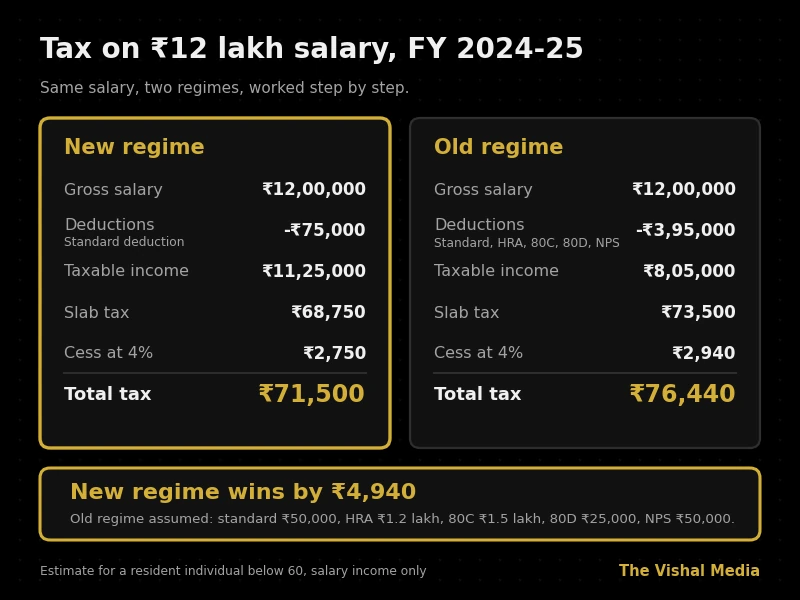
Taxable income is ₹8,05,000. Tax is ₹12,500 (₹2.5 to ₹5 lakh at 5%) plus ₹61,000 (₹3.05 lakh at 20%), which is ₹73,500. With cess, ₹76,440. The new regime on the same salary costs ₹71,500, so it wins by ₹4,940 even though this person claimed almost ₹4 lakh in deductions.
Old vs New Tax Regime: Where Was the Tipping Point?
For each salary, here is how much total old-regime deduction (including the ₹50,000 standard deduction) you needed before the old regime matched the new one. These figures assume salary income only, a resident below 60, and no employer NPS, which helps both regimes.
| Gross salary | New regime tax (with cess) | Old-regime deductions needed to match |
|---|---|---|
| ₹10,00,000 | ₹44,200 | about ₹3.50 lakh |
| ₹12,00,000 | ₹71,500 | about ₹4.19 lakh |
| ₹15,00,000 | ₹1,30,000 | about ₹4.58 lakh |
| ₹20,00,000 | ₹2,78,200 | about ₹4.83 lakh |
Now compare that with the most common deduction package: standard deduction, full 80C, 80D for self and NPS adds up to ₹2.75 lakh. That falls short at every salary level above. The old regime only won if you also had meaningful HRA exemption or home loan interest. If you do not have rent or a home loan, the new regime was almost always cheaper.
Want to test your own deductions? Run your numbers in the income tax calculator above before comparing regimes.
Missed Your FY 2024-25 ITR? How ITR-U (Updated Return) Works Now
For ITR filing FY 2024-25, the original due date of 31 July 2025 was extended to mid-September, and the final date was 16 September 2025. The last date to file ITR for AY 2025-26 as a belated return or revised return came later. That window ran until 31 December 2025, with a Section 234F late fee of ₹1,000 if income was below ₹5 lakh and up to ₹5,000 above it. Both windows have closed.
What remains is the updated return (ITR-U) under Section 139(8A), filed on the Income Tax e-filing portal. It can be filed up to 31 March 2030. The catch is the price. An additional tax applies on your tax plus interest: 25% if filed within 12 months after the assessment year ends, 50% in the second year, 60% in the third and 70% in the fourth. For AY 2025-26, the 25% rate holds if you file by 31 March 2027.
Here is what that looks like. Suppose a freelancer never filed and owes ₹40,000 of tax plus ₹6,000 of interest. Filing in December 2026 adds 25% of ₹46,000, which is ₹11,500. Waiting until April 2027 doubles the rate to 50%, so the same return costs an extra ₹23,000. A late fee under Section 234F can also apply if the original return was never filed. If you freelance or run a small business, our business guides cover the money side too.
Two limits matter. An ITR-U cannot reduce your tax or create or increase a refund. If you were owed a refund and missed the deadline, the remaining route is a request to the tax authorities to condone the delay, and that is a conversation to have with a Chartered Accountant. Also, the Finance Act 2026 amended the ITR-U rules from 1 March 2026, so confirm the current position with your CA before you file.
Why Your Tax Differs From Form 16 and AIS
A gap of a few thousand rupees usually has a boring cause:
-
Other income. Form 16 covers salary only. Savings and FD interest, dividends and capital gains belong in the return but not in the form.
-
Regime used for TDS. Your employer deducted tax under the regime you declared. For a salaried taxpayer, the regime you choose in the return decides the final tax, so the two can differ.
-
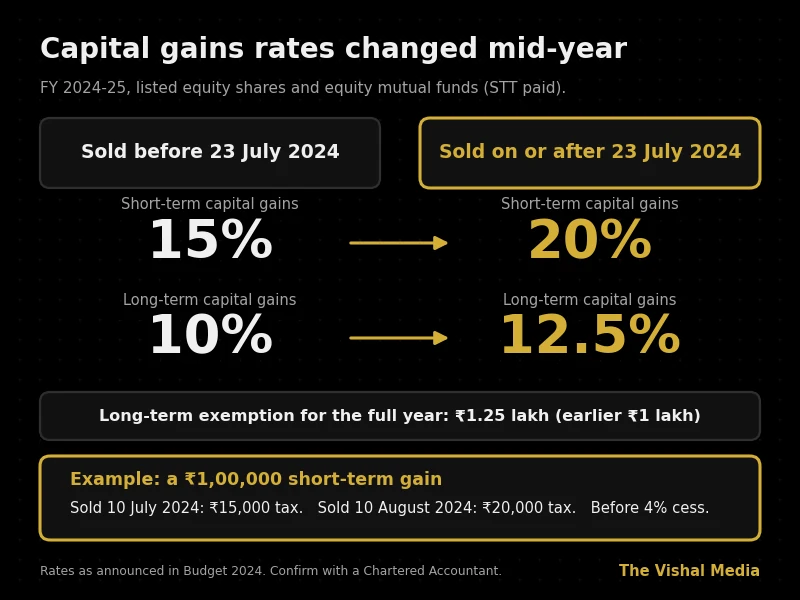
Capital gains rates that changed mid-year. This is the one most calculators ignore. For listed equity, short-term gains (STCG) were taxed at 15% before 23 July 2024 and 20% after, and long-term gains (LTCG) at 10% before and 12.5% after. The long-term exemption rose from ₹1 lakh to ₹1.25 lakh. A ₹1,00,000 short-term gain sold on 10 July 2024 cost ₹15,000 in tax. The same gain sold on 10 August 2024 cost ₹20,000, both before cess.
-
TDS credits. Check Form 26AS and the AIS against what your employer reported. A missing credit makes your tax look higher than it is.
Mistakes That Trip People Up
-
Using ₹50,000 as the new-regime standard deduction. That was the previous year’s number.
-
Claiming 80C or HRA while computing in the new regime. They cannot be mixed.
-
Treating ₹7 lakh as a cliff. Marginal relief softens it, as Example 2 showed.
-
Forgetting cess. It is 4% on tax after rebate, and it is easy to leave out.
-
Using the wrong year on an income tax calculator. Make sure it says AY 2025-26 or FY 2024-25.
How We Verified This Guide
The Vishal Media checked slab rates, deductions, deadlines and ITR-U rates against primary sources [REVIEWER: confirm the primary sources, for example the Finance (No. 2) Act 2024 on the Income Tax Department’s Finance Acts page] and cross-checked them against at least one professional tax resource. The worked examples were calculated from the slabs on this page. Read how we research and review our guides in our editorial policy. This article was last reviewed on 3 November 2026. Tax rules change, so if you spot a figure that has moved, tell us and we will update it.
Frequently Asked Questions
What was the default regime for FY 2024-25 if I never chose one?
The new tax regime. It is the default system, and you had to actively opt for the old regime.
How is cess calculated?
It is 4% of your tax after the rebate or marginal relief, plus surcharge if any. On ₹1,25,000 of tax, cess is ₹5,000.
Is surcharge a concern for a ₹30 lakh salary?
No. Surcharge begins above ₹50 lakh of taxable income, so it matters only for high earners.
Does the new Income-tax Act 2025 reopen my FY 2024-25 tax?
No. Even a notice issued in 2026 for AY 2025-26 is handled entirely under the 1961 Act.
Which income tax calculator year should I use for FY 2024-25?
Choose AY 2025-26, or label FY 2024-25. Picking AY 2026-27 applies a later year’s rules.
Check Your FY 2024-25 Tax Before You Act
Getting the year and the regime right takes a few minutes, while a wrong assumption can cost you real money. Here is what to do next:
-
Run your numbers. Use the income tax calculator and compare both regimes before you decide anything.
-
Missed filing? Talk to a CA before 31 March 2027, when the 25% ITR-U rate steps up to 50%.
-
Save this guide. Use the Save button on this page so you can find it again before the next filing season.
-
Share it. Send this guide to a colleague or family member on WhatsApp who has the same question.
-
Have a tax question? Send it to us and The Vishal Media may cover it next.
-
Keep reading. Browse more personal finance guides, or follow new ones through our RSS feed.
Disclaimer
This article is general information, not personal tax advice. Tax rules change, and your situation may differ. The figures here are estimates for a resident individual and do not cover every case, such as capital gains at special rates, business income or alternative minimum tax. Please confirm your numbers with a qualified Chartered Accountant before filing. See our full disclaimer.