


Put ₹1.5 lakh into PPF every year for 15 years at 7.1% and a PPF calculator will show ₹40,68,209 at the end, as long as each deposit lands by 5 April. Spread the same money over twelve deposits of ₹12,500 a year and the figure drops to about ₹39.45 lakh. Pay it all in March and it falls to about ₹37.99 lakh. The total you put in is the same ₹22.5 lakh each time, yet the result differs by nearly ₹2.7 lakh.
Most calculators never mention this. They ask for a yearly amount, a number of years and a rate, then print one number. This guide from The Vishal Media shows what that number assumes, why two popular calculators can disagree on the same inputs, and how your deposit date changes what you end up with.
What a PPF calculator asks for, and what it quietly assumes
The calculators on Groww and Axis Max Life both ask for the same three things: a yearly investment, a number of years and an interest rate. They return the amount invested, the total interest and the maturity value. Groww’s own example is ₹1,50,000 a year for 15 years at 7.1%, which it puts at about ₹40,68,209. Axis Max Life’s example is ₹1,00,000 a year for 15 years, which it puts at ₹27,12,139.
When we recalculated both, they matched exactly, and only under one assumption: the full year’s deposit sits in the account from the start of the year and earns a full year of interest. Neither page says so in plain words. That is the quiet assumption behind every result you see in the next few sections.
Today’s PPF interest rate
The PPF interest rate is 7.1% a year for the October to December 2026 quarter. Business Today reported on 30 September 2026 that the government kept it unchanged, and the India Post savings page, last updated on 16 November 2026, also lists PPF at 7.1% compounded yearly. We checked both on 23 November 2026.
The rate is reviewed every quarter, so it is not locked in for your 15 years. A calculator that holds 7.1% steady for the whole period is giving you a reasonable estimate, not a promise. Treat the maturity figure as a planning number and re-run it when the rate changes.
PPF calculator results for ₹1.5 lakh a year
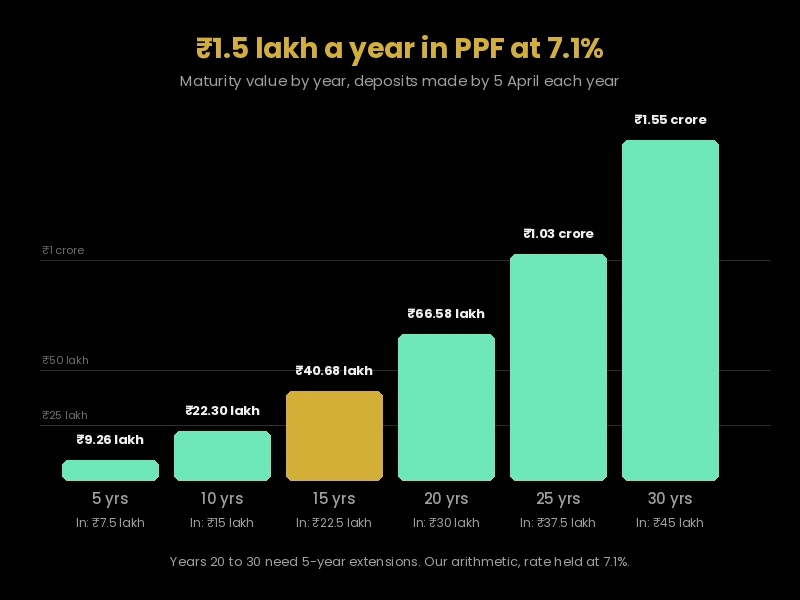
The table below uses ₹1,50,000 a year, deposited by 5 April each year, at a constant 7.1%.
| Years | Total invested | Interest earned | Maturity value |
|---|---|---|---|
| 5 | ₹7,50,000 | ₹1,75,701 | ₹9,25,701 |
| 10 | ₹15,00,000 | ₹7,30,124 | ₹22,30,124 |
| 15 | ₹22,50,000 | ₹18,18,209 | ₹40,68,209 |
| 20 | ₹30,00,000 | ₹36,58,288 | ₹66,58,288 |
| 25 | ₹37,50,000 | ₹65,58,015 | ₹1,03,08,015 |
| 30 | ₹45,00,000 | ₹1,09,50,911 | ₹1,54,50,911 |
Somewhere between year 15 and year 20, the interest earned overtakes the money you paid in. That is the point where PPF stops feeling slow. SBI’s PPF page says the account can be extended in blocks of 5 years after the first 15, so the 20, 25 and 30 year rows assume you extend and keep depositing.
How PPF interest is really worked out
Here is the detail most calculators skip. According to SBI’s PPF page, interest is calculated on the lowest balance in the account between the 5th and the last day of each month, and it is credited on 31 March every year. So interest is worked out month by month and added once a year, which is why India Post describes it as compounded yearly.
A real example shows what that means. Say you deposit ₹1,50,000 on 4 April. That money counts for April, and at 7.1% it earns about ₹888 for the month (₹1,50,000 × 7.1% ÷ 12). Deposit the same amount on 6 April and April earns nothing on it, because the 5th has already passed. Interest starts counting from May.
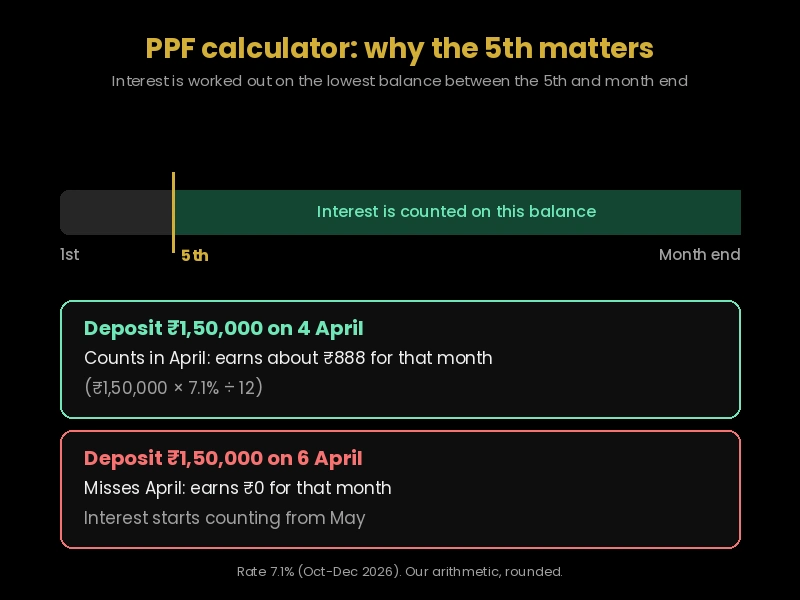
One missed month is small. Repeat it for 15 years and the effect is large, as the next section shows.
Same ₹22.5 lakh, three deposit habits
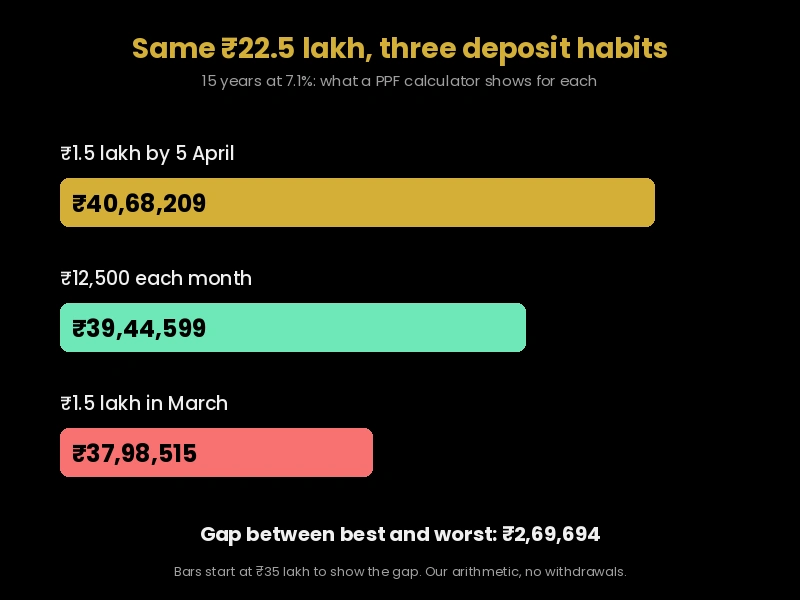
We ran the same 15 years at 7.1% with four different ways of paying in ₹22.5 lakh. The first row is the standard calculator result. The others apply the monthly interest rule.
| How you deposit | When the money goes in | 15-year maturity |
|---|---|---|
| Lump sum by 5 April | ₹1,50,000 in April, on or before the 5th | ₹40,68,209 |
| Monthly, on time | ₹12,500 every month, on or before the 5th | ₹39,44,599 |
| Monthly, always late | ₹12,500 every month, after the 5th | ₹39,22,125 |
| Lump sum in March | ₹1,50,000 each March | ₹37,98,515 |
The best and worst rows are ₹2,69,694 apart. Within monthly deposits, paying after the 5th instead of before it costs ₹22,474 over 15 years. These are our own calculations: monthly interest at 7.1% ÷ 12 on each month’s balance, credited once a year, no withdrawals. A real passbook can differ by a few rupees because of rounding.
What does that mean in practice? If you have the full ₹1.5 lakh in hand, depositing in the first four days of April is the best option. If your money comes monthly with your salary, a standing instruction that moves it between the 1st and the 4th keeps you on the right side of the cut-off. One caution: do not drain your emergency fund to reach ₹1.5 lakh in April. A gain of a few lakh over 15 years is not worth a cash crunch in year two.
Why two PPF calculators can give different answers
The formula most pages print is F = P × ((1 + i)^n - 1) / i, where P is the yearly amount, i is the rate as a decimal (0.071, not 7.1) and n is the number of years. Applied exactly as printed to ₹1,50,000 for 15 years, it gives ₹37,98,515. That is the March case in our table, because the formula treats each deposit as made at the end of the year.
Groww’s printed example says ₹40,68,209, which is the same figure multiplied by 1.071. Axis Max Life’s example writes (1 + 7.1) in place of (1 + 0.071), and its ₹27,12,139 also matches the start-of-year method, while the printed formula would give ₹25,32,343 for that example. So the numbers on those pages are consistent with deposits made by 5 April. The printed formula is simply missing the last step. For April deposits, use F = P × ((1 + i)^n - 1) / i × (1 + i).
Rules to check before you rely on the numbers
Three rules are stated the same way by SBI and Axis Max Life. The minimum deposit is ₹500 a year, the maximum is ₹1.5 lakh a year, and the first term is 15 years. SBI adds that anything above ₹1.5 lakh earns no interest and gets no tax rebate. On tax, SBI describes the interest as exempt from income tax, and Axis Max Life says the deposits qualify for Section 80C under the old tax regime.
We have not covered partial withdrawal limits, loan terms, premature closure conditions or the position of NRIs. We could not confirm them from the official scheme text, and the Department of Economic Affairs lists separate notices on closure and on NRI accounts that we did not read in full. For those, check the Public Provident Fund Scheme 2019 or ask your bank or post office before you plan around them.
Which deposit style fits you
| Your situation | Better fit | Why |
|---|---|---|
| You have ₹1.5 lakh ready in April | One deposit before the 5th | Counts for all 12 months, which gives the highest result |
| You are salaried, no lump sum | A monthly standing instruction between the 1st and 4th | Keeps every month inside the cut-off |
| Your income is irregular | Deposit when you can, before the 5th of that month | Each deposit starts earning from that month, and the ₹500 yearly minimum keeps you on track |
| ₹1.5 lakh is more than you can spare | Use the calculator to test a smaller amount | A ₹500 monthly deposit for 15 years gives about ₹1,57,784 on ₹90,000 invested |
Frequently asked questions
How much will ₹1.5 lakh a year in PPF become in 15 years?
About ₹40,68,209 at 7.1%, if every deposit reaches the account by 5 April. Of that, ₹22,50,000 is your money and ₹18,18,209 is interest. If the rate changes in later quarters, the real figure will move with it.
What is the PPF interest rate now?
It is 7.1% a year for October to December 2026, announced on 30 September 2026. The government revises it every quarter, so check the India Post or your bank’s page before each new financial year.
Is PPF interest compounded monthly or yearly?
It is worked out monthly on the lowest balance between the 5th and month end, then credited once a year on 31 March. After that, the credited interest earns interest too, which makes it yearly compounding.
Does the date of deposit really matter?
Yes. A deposit made after the 5th does not earn interest for that month. On ₹1.5 lakh at 7.1%, a single month is worth about ₹888, and across a 15-year monthly habit the gap we calculated is ₹22,474.
What would ₹500 a month in PPF grow to?
At 7.1% for 15 years, with each deposit made by the 5th, about ₹1,57,784 on ₹90,000 invested. That is our estimate, so your passbook may differ slightly.
Why do online PPF calculators show different maturity amounts?
Mostly because of the deposit-timing assumption and a printed formula that leaves out one step, as explained above. Check whether a calculator says when it assumes you pay in, and prefer one that lets you pick monthly deposits.
What to do next
Pick one deposit habit and write down its date. If you have a lump sum, set a reminder for 1 April. If you are on a salary, set the standing instruction for the 2nd. Then run your own numbers in a calculator and note the rate and the date next to the result, so you know what you were assuming.
If the PPF rate changes or you spot an error in this article, tell us through the contact form. To compare PPF with a market-linked option, read our guide on what is SIP investment, and for more money explainers browse the Finance section.
Disclaimer
This article is for general information and is not financial, tax or legal advice. Maturity figures are estimates based on a constant 7.1% rate, a stated deposit pattern and no withdrawals, as of 23 November 2026. Rules and rates can change, and details we could not verify are marked above. Confirm them with the official scheme text, your bank or your post office before you decide. See our disclaimer for more.