


In October 2026, about 59 lakh SIPs in India were stopped or ran out their tenure, while only about 51 lakh new ones were started. That one number says a lot about how people treat this tool. This guide from The Vishal Media, part of our Finance guides, explains what is SIP investment really is, how it works with a worked example, how the gains are taxed, and what you can do to avoid becoming part of that statistic.
What is SIP investment?
SIP stands for Systematic Investment Plan. You pick a mutual fund scheme, an amount and a date once, and the money is debited automatically from your bank account every month. Each instalment buys units of the fund at that day’s NAV, which is simply the price of one unit.
Beginners often miss one point: a SIP is not an investment product. It is a method of buying one. The product is the mutual fund, and you can buy the same fund through a SIP or in one go as a lump sum. Your returns come from the fund’s holdings and the market, not from the SIP label.
The method is popular. AMFI data for June 2026, as reported by Business Standard, shows about 10.5 crore active SIP accounts and monthly SIP contributions of about ₹31,781 crore.
How a SIP works: a worked example
Say you invest ₹5,000 every month in an equity fund, and the NAV moves like this over four months.
| Month | NAV | Amount invested | Units bought |
|---|---|---|---|
| 1 | ₹100 | ₹5,000 | 50.00 |
| 2 | ₹90 | ₹5,000 | 55.56 |
| 3 | ₹80 | ₹5,000 | 62.50 |
| 4 | ₹100 | ₹5,000 | 50.00 |
| Total | ₹20,000 | 218.06 |
Your average cost works out to about ₹91.72 per unit, even though the NAV started and ended at ₹100. At the month 4 NAV, your 218.06 units are worth about ₹21,806, a gain of roughly 9% on ₹20,000. This effect is called rupee cost averaging: a fixed amount buys more units when prices fall and fewer when they rise.
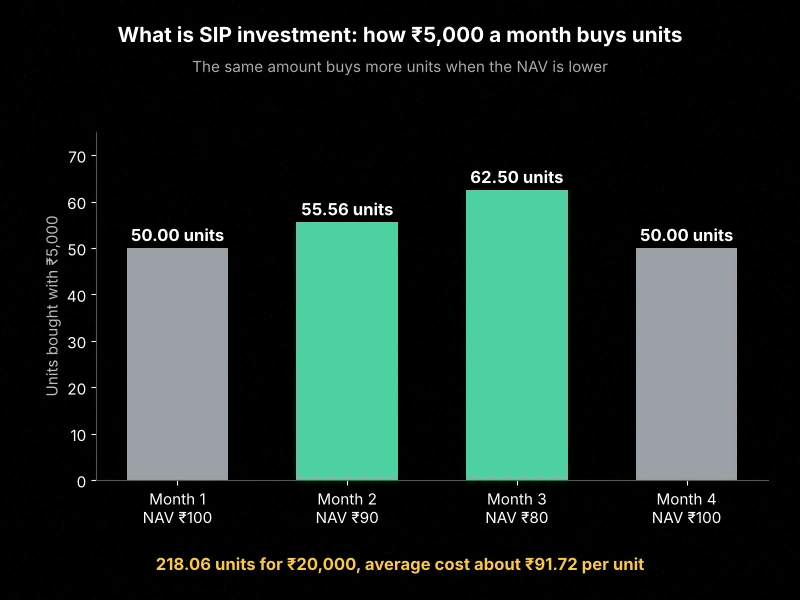
Now the honest part. Suppose you stop after month 3, when the NAV is ₹80. You hold 168.06 units worth about ₹13,444 against ₹15,000 invested, a loss of about 10.4%. The NAV fell 20%, so averaging softened the blow, but it did not remove it. A SIP does not protect you from a falling market. It only spreads your entry price.
SIP, mutual fund and lump sum: how they differ
| Mutual fund | SIP | Lump sum | |
|---|---|---|---|
| What it is | A pooled fund run by a professional manager | A way of buying a fund in regular instalments | A way of buying a fund in one payment |
| Best suited to | Any investor with a goal | Regular income, such as a salary | Money that arrives at once, such as a bonus |
| Market exposure | Depends on the fund | Spread across many dates | Full amount from day one |
Neither route is automatically safer. With a lump sum your whole amount faces the market on day one. With a SIP, your later instalments still face whatever the market does next.
Types of SIP
-
Regular SIP: a fixed amount at a fixed interval. Fund houses offer different frequencies, and monthly is the most common.
-
Step-up SIP: the instalment rises by a set amount or percentage each year, so it can grow with your income.
-
Flexible SIP: you can vary the amount within limits set by the fund house.
-
Fixed-tenure or perpetual SIP: you either choose a number of instalments (such as 12, 24, 36 or 60) or let it run until you stop it.
How SIP gains are taxed
Tax is where most SIP guides stay silent, even though it decides how much of your gain you keep. The Income-tax Act, 2025 replaced the 1961 Act from 1 April 2026. Rates did not change, but most section numbers did, so this article describes the rules by name.
| Type of fund | Holding period | Tax on gains |
|---|---|---|
| Equity-oriented funds | 12 months or less | 20% (short-term) |
| Equity-oriented funds | More than 12 months | 12.5% on gains above ₹1.25 lakh in a financial year |
| Debt funds bought on or after 1 April 2023 | Any period | Added to your income and taxed at your slab rate |
Health and education cess of 4% is added to the tax on top.
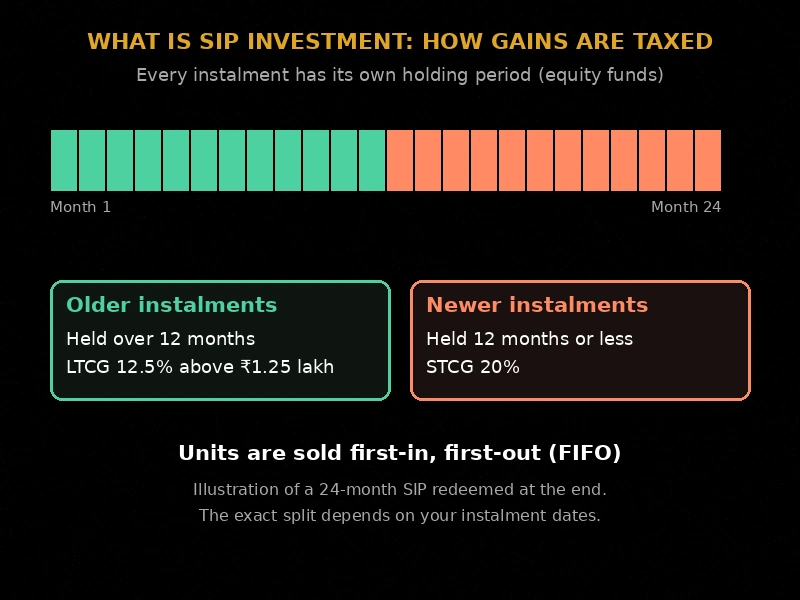
The part most people miss: each SIP instalment is treated as a separate purchase with its own holding period. When you redeem, the oldest units are sold first, which is called FIFO (first in, first out). So a redemption from a long-running SIP can include both long-term and short-term units. The age of the SIP does not decide anything. The age of each instalment does.
Here is an example. In one financial year, you redeem units from a SIP and make a long-term gain of ₹1,00,000 and a short-term gain of ₹40,000 in an equity fund. The long-term gain is below the ₹1.25 lakh exemption, so it carries no tax. The short-term gain is taxed at 20%, which is ₹8,000, plus ₹320 cess, so ₹8,320 in total.
ELSS funds: these tax-saving equity funds qualify for a deduction of up to ₹1.5 lakh, but only if you choose the old tax regime. Our income tax calculator guide shows how the old and new regimes compare, though its worked examples use FY 2024-25 slabs. That deduction used to sit in Section 80C and is now in Section 123 of the new Act. Each ELSS instalment also has its own three-year lock-in. These rates and rules were checked in November 2026, so confirm them on the Income Tax Department website or with a chartered accountant before you redeem.
Why so many SIPs stop
The AMFI stoppage ratio divides the SIPs stopped or completed in a month by the new SIPs registered in the same month. In October 2026 it jumped to about 115.7%, from 78.5% in September, with about 59 lakh SIPs ending against about 51 lakh new ones. Between May and September the ratio had been falling, from 95.5% to 78.5%.
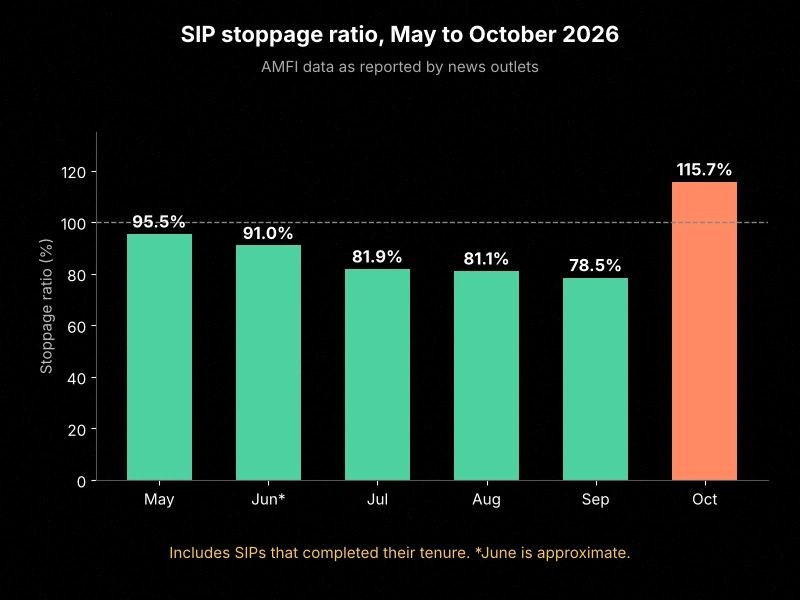
Read this number carefully. It counts SIPs, not people, and one investor can run several. It also includes SIPs that simply reached the end of their planned tenure. So it does not mean 116 out of every 100 investors quit. It does show that a large number of SIPs end every month. The data cannot tell you why, so treat any single reason as a guess. Three things you can control, though, are worth knowing:
-
Failed debits. There is no penalty from the fund house for a missed instalment, but your bank may charge a bounce fee. For daily, weekly, fortnightly and monthly SIPs, three consecutive failed debits can cancel the SIP, and for quarterly or bimonthly SIPs the limit is two. Keep a small buffer in the account on the debit date.
-
An amount set too high. A SIP sized to your very last spare rupee tends to break in the first expensive month.
-
Stopping after a fall. UTI Mutual Fund’s own explainer makes the point that quitting during a fall can hurt your goals, because lower prices mean more units for the same amount.
How much should you start with?
There is no magic percentage. Work through these five checks instead.
-
Emergency fund first. Keep money for bills and surprises outside any market-linked fund.
-
Fixed outgoings. Subtract EMIs, rent and bills from your income before deciding the SIP amount. If a personal loan is among them, our personal loan guide shows how to judge its real cost.
-
Goal and time. Equity funds suit goals that are several years away, not next year’s expenses.
-
An amount you can keep through a bad month. Consistency beats a big amount you will stop.
-
A yearly step-up. Raising the instalment when your income rises does more than hunting for the perfect fund.
Many schemes accept SIPs from ₹500 a month, and some from ₹100, so the starting amount is rarely the obstacle.
Direct plan or regular plan?
Every mutual fund scheme comes in two versions with the same portfolio. A direct plan has no distributor commission built into its expense ratio, so it is usually cheaper, and the gap is commonly quoted at 0.5% to 1% a year. The regular plan pays a commission to the distributor or adviser who sold it to you.
Here is what a 1 percentage point gap does to a ₹10,000 monthly SIP over 20 years. At an assumed 12% return in the direct plan, the corpus is about ₹98.9 lakh. At 11% in the regular plan, it is about ₹86.6 lakh. That is a difference of about ₹12.4 lakh on ₹24 lakh invested. These figures come from a month-end instalment calculation with monthly compounding, and other calculators give slightly different numbers.
Two recent changes matter here. SEBI’s revised expense framework, effective from 1 April 2026, now separates the base expense ratio from other charges. And SEBI’s chairman announced on 28 October 2026 that direct plans would become the default option on fund houses’ own digital platforms from 1 November 2026. Regular plans are not wrong. If you want an adviser’s ongoing help, the commission pays for that service, but compare what you get with what you pay.
How to start a SIP
-
Decide your goal and time horizon. This decides the type of fund.
-
Complete KYC. You will need your PAN, Aadhaar, address proof and bank details.
-
Choose a scheme that matches your risk level. Read the scheme’s risk label and offer document first.
-
Set the amount, date and frequency.
-
Set up the auto-debit mandate from your bank account. Check that the account number and IFSC code are correct, because mandate problems are one reason SIP debits fail.
-
Review once or twice a year, not every day.
You can invest through a fund house’s own website or app, a bank, or a distributor. A genuine distributor holds an AMFI registration number (ARN), which you can check on the AMFI website, and an investment adviser should be registered with SEBI. If you are still deciding between funds and shares, our beginner’s guide on how can I invest in share market covers the other route.
Five SIP myths
-
“A SIP guarantees returns.” It does not. A SIP is a method, and the return depends on the fund and the market.
-
“A SIP is always safer than a lump sum.” The later instalments still carry market risk, as the worked example showed.
-
“After one year, every unit is long-term.” Each instalment has its own clock, and only the ones older than 12 months qualify.
-
“SIPs are only for equity funds.” You can run a SIP in debt, hybrid and index funds too.
-
“You need a large amount.” Many schemes start at ₹500 or less.
Frequently asked questions
What is the minimum amount for a SIP?
It depends on the scheme. Many accept ₹500 a month and some accept ₹100, so check the scheme’s enrolment form.
What happens if I miss an instalment?
The fund house does not charge a penalty, but your bank may charge a bounce fee. Repeated consecutive failures can cancel the SIP, and your existing units stay invested.
Which NAV does a SIP instalment get?
Units are allotted at the NAV applicable on the day the fund house receives your instalment, under the scheme’s cut-off rules. Your account statement shows the exact NAV and date for every instalment.
Can I stop a SIP at any time?
Yes. Stopping the SIP does not cost anything, but an exit load may apply to units you redeem within the scheme’s exit-load period, and it applies separately to each instalment.
Is there a SIP for individual shares?
Some platforms offer recurring purchases of single shares, often called stock SIPs. They carry the risk of one company, which a diversified fund does not. This article covers mutual fund SIPs. If you want to buy shares directly, start with our beginner’s guide to investing in the share market.
Final word
A SIP is a habit-building tool, not a shortcut to returns. Know the fund you buy, keep the amount comfortable, remember that each instalment is taxed on its own clock, and keep a buffer in your account so a failed debit does not end it for you.
Before you start
Walk through the five checks above before you set up your first SIP. For more plain-language money guides, browse the Finance section of The Vishal Media. If you spot a figure or rule that has changed, tell us and we will fix it.
More money guides from The Vishal Media
-
How can I invest in share market: a beginner’s 30-day plan with real costs and safety checks
-
Personal loan checks before you borrow: compare real rates, read the KFS and verify loan apps
-
Income tax calculator guide: old vs new regime with worked examples
-
Browse every article in our Finance section
Disclaimer
This article is for education only and is not investment, tax or legal advice. We do not recommend any scheme, fund house or platform. Mutual fund investments are subject to market risks, and returns are not guaranteed. Tax rules and rates can change, so confirm current details with your fund house, the Income Tax Department or a qualified professional before you invest or redeem. Read our full disclaimer.