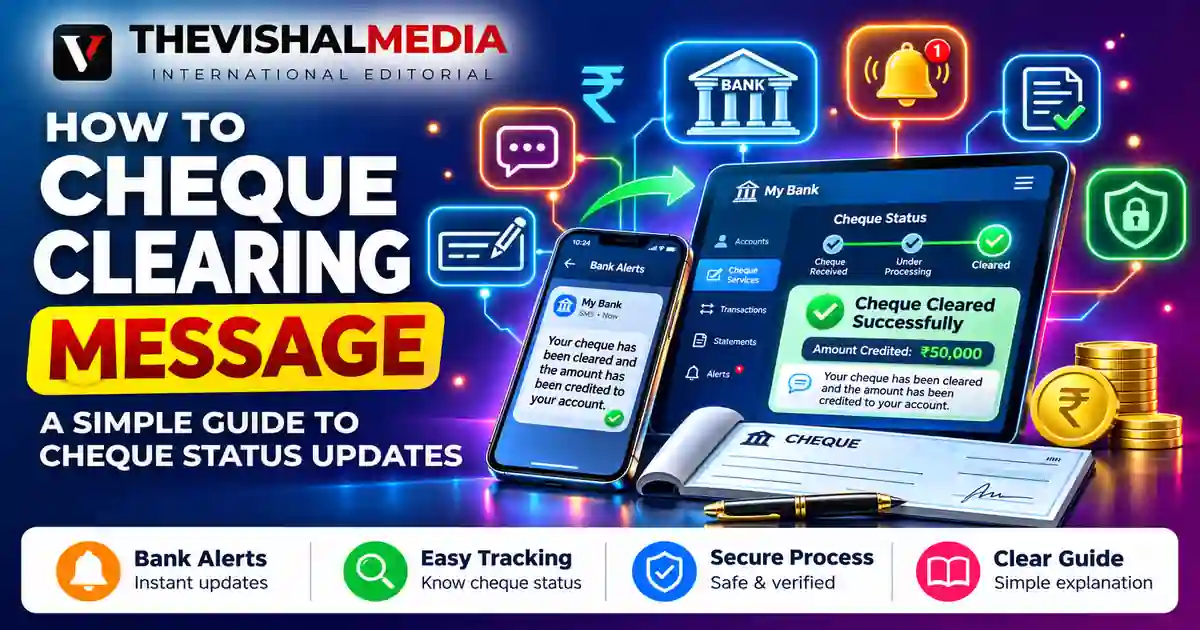

Not long ago, depositing a cheque meant waiting a day or two for the money. Under the RBI’s continuous clearing rules, that wait is now counted in hours, which is why the alert from your bank matters more than it used to. This guide from The Vishal Media explains what every cheque clearing message means, how long clearing should take now, and what to do when the message is late, negative or looks fake.
What is a cheque clearing message?
It is a notification from your bank, usually an SMS and sometimes an app alert, that tells you what is happening to a cheque. There are two kinds, and most guides mix them up.
-
Outward alerts: you deposited a cheque, and the bank tells you it was received, credited or returned.
-
Inward alerts: you issued a cheque, and the bank tells you it has been presented for payment. Some banks send these only if you register for them. DBS, for example, offers inward cheque clearing SMS alerts on a signed request, so that you can report a suspicious cheque immediately.
Always check which kind of message you have received, because the action you need to take is different.
How cheque clearing works now
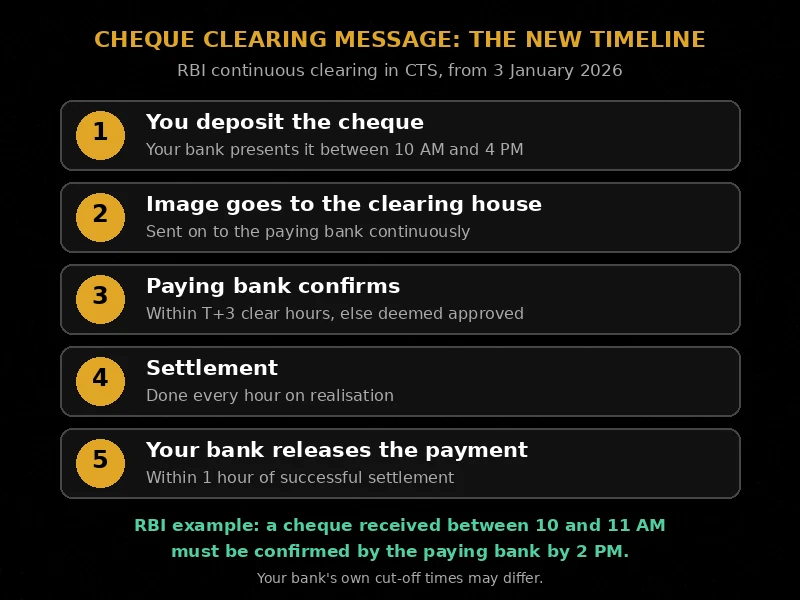
The RBI moved the Cheque Truncation System (CTS), where a cheque’s image travels instead of the paper, from batch processing to continuous clearing. Phase 1 started on 4 October 2025, and phase 2 started on 3 January 2026. Here is what the RBI’s circular says.
-
One presentation session. Banks send cheque images to the clearing house continuously between 10 AM and 4 PM.
-
Quick confirmation. The paying bank must confirm each cheque, positively or negatively, within T+3 clear hours. If it does not, the cheque is treated as deemed approved and goes into settlement.
-
Hourly settlement. The clearing house settles on realisation, in hourly runs, instead of at the end of the day.
-
Quick payment. Your bank must release the payment to you immediately, and not later than one hour after successful settlement.
The RBI’s own example: a cheque received between 10 AM and 11 AM has to be confirmed by 2 PM. So a cheque presented in the morning can be credited the same afternoon in the best case. Your bank’s own cut-off times, verification checks and holidays can add time, and some banks set an earlier counter cut-off for same-day presentation. One bank’s collection policy, for instance, mentions 1:30 PM.
The SMS you may get, decoded
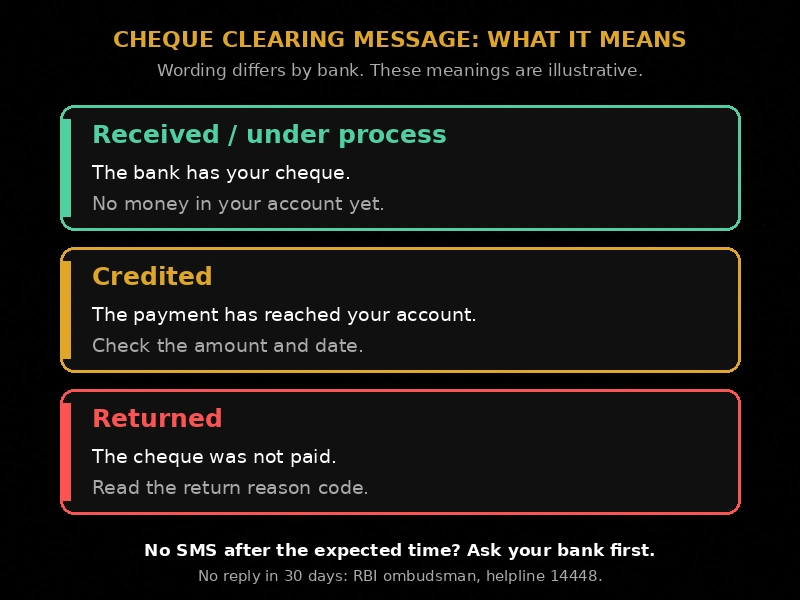
The RBI does not prescribe how banks word these alerts, so the examples below describe meanings, not exact texts.
| What the message says | What it usually means | What to do |
|---|---|---|
| Cheque received, or accepted for collection | The bank has your cheque and will present it. The money is not in your account yet. | Keep the acknowledgement slip. Banks must give one if you ask for it. |
| Cheque under process, or in clearing | The cheque has been presented and is waiting for the paying bank’s confirmation. | Allow the time window above. If it stays pending beyond the working day, ask the bank. |
| Cheque credited, or cleared | The payment has reached your account. | Check the amount and date in your statement. |
| Cheque returned, or unpaid | The paying bank did not pay it. | Read the return reason code and act on it (see the next section). |
| Cheque presented for clearing (inward alert) | A cheque issued by you has reached your bank for payment. | Check the number, amount and payee. If you did not issue it, call the bank immediately. |
Why a cheque is returned: the reason codes
A returned cheque comes with a return memo that carries a reason code from a standard list that banks follow. Most guides give three reasons. The common groups are below, and the list is illustrative, so your bank’s memo is the final word.
| Codes | Reason | How to fix it |
|---|---|---|
| 01, 02, 03 | Funds insufficient, exceeds arrangement, effects not cleared (present again) | The drawer must arrange funds. For code 03, present the cheque again. |
| 04, 05 | Refer to drawer, or contact the drawer or bank and present again | Contact the drawer and the paying bank. |
| 10 to 17 | Signature incomplete, illegible, different, required or not as per mandate, or alteration needs the drawer’s authentication | The drawer should sign as per the bank’s records, or issue a fresh cheque. |
| 20 to 25 | Payment stopped by the drawer, by an attachment or court order, or because the account holder died or became insolvent | Speak to the drawer. Court orders need legal advice. |
| 30 to 34 | Post-dated, stale, undated, mutilated, or amount in words and figures differ | Ask for a properly drawn fresh cheque. |
| 85 | Alteration on the cheque other than the date | Cheques with cuttings or overwriting are not accepted under CTS. Ask for a fresh cheque. |
Banks’ own policies say that cheque return charges apply only where the customer is at fault, so ask the bank to explain any charge for a return that was not your fault.
What to do at each stage
-
No alert after the expected time: check your passbook or app first. Then ask the branch for the cheque’s status, using your acknowledgement slip.
-
Under process for too long: ask the bank for the status in writing or through the app. If the paying bank has not responded within the time limit, the cheque is deemed approved and moves to settlement.
-
Credited, but the amount looks short: for collections up to ₹1,00,000 in a savings account, the RBI says banks should not charge a service fee. Above that, or for other account types, ask for the bank’s cheque collection policy.
-
Returned: read the code, fix the problem and present the cheque again, or ask the drawer for a fresh one. If the code is 01 or 02, the legal route below may apply.
-
An inward alert for a cheque you did not issue: call your bank immediately and ask it to stop payment, then follow the fraud steps below.
If the cheque bounces for lack of funds: Section 138
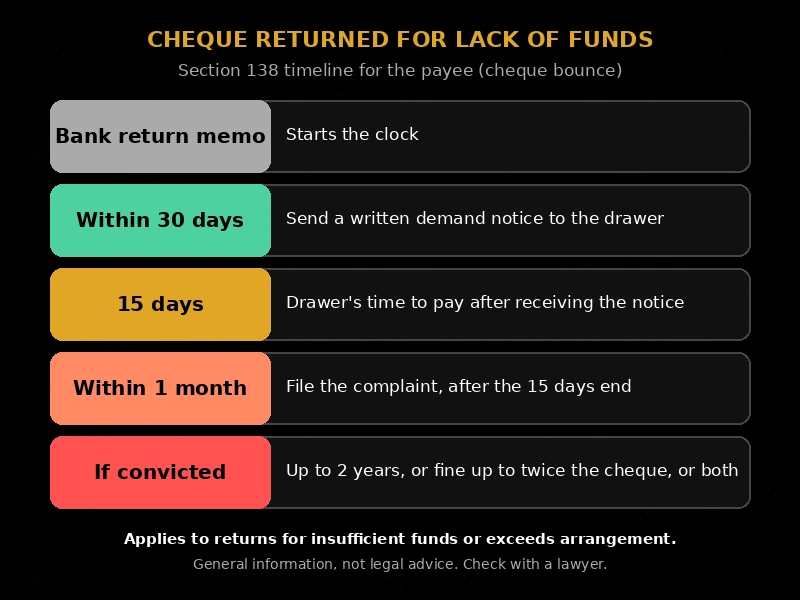
If a cheque is returned because the account has insufficient funds or the amount exceeds the arrangement with the bank, Section 138 of the Negotiable Instruments Act, 1881 may apply. Other return reasons, such as a signature problem, generally do not attract this section. For the payee, the timeline is tight.
-
Within 30 days of receiving the bank’s return information, send a written demand notice to the drawer.
-
The drawer then has 15 days from receiving the notice to pay.
-
If the drawer does not pay, the complaint must be filed before a Magistrate within one month after those 15 days end.
On conviction, the punishment can be up to two years in prison, a fine of up to twice the cheque amount, or both. If the drawer pays within the 15 days, no offence under Section 138 is made out. The offence can also be settled through compounding. If you are the drawer, paying in time ends the criminal exposure. This section is general information and not legal advice, so talk to an advocate before you send or reply to a notice, and read the Act itself on the India Code website.
If the cheque was for a loan instalment, the missed payment can affect your credit record. Our personal loan guide explains how to read loan terms and avoid costly surprises.
Is this message genuine?
Fake bank messages are common, and the same rules apply to cheque alerts.
-
A real alert never needs you to do anything online. You can always open your bank’s app or passbook yourself to check the status.
-
Banks do not ask for your OTP, PIN, CVV or password by SMS, call or link, so never share them.
-
Check the sender. Banks usually send alerts from a registered short code, not from an ordinary 10-digit mobile number.
-
Watch for pressure and typos. A scary deadline, a link to click or odd spelling is a red flag.
-
If you have clicked or shared something, call your bank at once and report it on 1930 or at cybercrime.gov.in. Keep the screenshots and the message.
For people who issue cheques
-
Positive Pay: you send the key details of a cheque (date, payee, amount) to your bank electronically before it is presented, and the bank matches them when it arrives. The RBI has advised banks to enable this for cheques of ₹50,000 and above, and banks may make it mandatory from ₹5,00,000.
-
Inward alerts: register for them if your bank offers them, so that you hear when a cheque you issued is presented.
-
No alterations: CTS does not accept cheques with cuttings or changes, so use a fresh leaf and write the payee name and amounts clearly in permanent ink.
If you are filling in a cheque for the first time, double-check the account details and IFSC code too. Our guide to the Airtel Payment Bank IFSC code shows how to avoid errors with bank details.
Charges and complaints
Under the RBI’s FAQ, banks must provide an acknowledgement when you hand in a cheque if you ask for one. If you have a complaint about non-payment or delay, raise it with the bank first. If the bank does not reply within 30 days, you can file a complaint under the Reserve Bank-Integrated Ombudsman Scheme, 2021, online at cms.rbi.org.in, and the toll-free helpline 14448 (9:30 am to 5:15 pm) can help you with the process. You can also ask your bank for a certified image of a cheque. A physical cheque must be requested from the presenting bank, and a charge may apply.
Frequently asked questions
When will I get a cheque clearing message?
That depends on your bank and on whether you have switched alerts on. Most banks send a message when a cheque is credited or returned. If you have received nothing, check your app or passbook and ask your branch.
What is the difference between “received” and “credited”?
“Received” only says that the bank has your cheque and will present it. “Credited” says that the money has reached your account.
What if my cheque is returned but my account has enough money?
Look at the return code. It may be a signature, date or amount mismatch, and the drawer’s account may be the one affected, not yours. Ask the drawer to check with the paying bank, or request a fresh cheque.
Is a bounced cheque always a criminal case?
No. Section 138 applies when the cheque is returned for insufficient funds or because it exceeds the arrangement, and only if the legal steps and deadlines are followed. Other return reasons generally do not attract it.
Can I see an image of the cheque I issued?
Yes. Banks can provide a certified image, and the original paper cheque stays with the presenting bank, which keeps it for 10 years.
Final word
A cheque clearing message is a small piece of text with a lot of information in it. Know which kind you have received, compare it with the timeline above, read the return code if it says returned, and never share an OTP because a message told you to.
Before you act
Check your latest cheque against the timeline and the return codes above. For more plain-language money guides, browse the Finance section of The Vishal Media. If you spot a rule or figure that has changed, tell us and we will fix it.
Disclaimer
This article is for general information only and is not legal, banking or financial advice. Bank processes and message wording differ, and rules can change, so confirm details with your bank, the RBI or a qualified professional before you act. Read our full disclaimer.